1. The Story of Visakha

    Comment

    Verse 213: Endearment begets sorrow, endearment begets fear. For him who is free from endearment there is no sorrow; how can there be fear for him?

    The Story of Visakha

    While residing at the Jetavana monastery, the Buddha uttered Verse (213) of this book, with reference to Visakha, the renowned donor of the Pubbarama monastery.

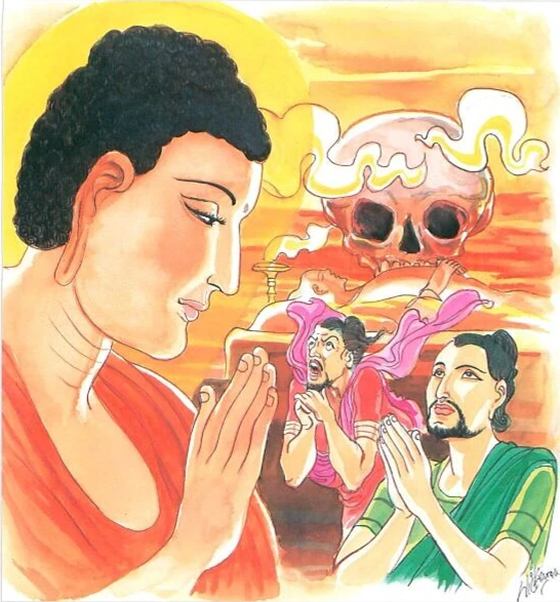
    One day, a granddaughter of Visakha named Sudatta died and Visakha felt very deeply about her loss and was sorrowing over the child’s death. So she went to the Buddha; when the Buddha saw her, he said, “Visakha, don’t you realize that many people die in Savatthi every day? If you were to regard all of them as you regard your own grandchild you would have to be endlessly weeping and mourning. Let not the death of a child affect you too much. Sorrow and fear arise out of endearment.” Continue reading

  2. The Story of a Rich Householder

    Comment

    Verse 212: Affection begets sorrow, affection begets fear. For him who is free from affection there is no sorrow; how can there be fear for him?

    The Story of a Rich Householder

    While residing at the Jetavana monastery, the Buddha uttered Verse (212) of this book, with reference to a rich householder who had lost his son.

    Once, a householder was feeling very distressed over the death of his son. He often went to the cemetery and wept there. Early one morning, the Buddha saw the rich householder in his vision. So, taking a bhikkhu along with him, the Buddha went to the house of that man. There, he asked the man why he was feeling so unhappy. Then, the man related to the Buddha about the death of his son and about the pain and sorrow he was suffering. To him the Buddha said, “My disciple, death does not occur only in one place. All beings that are born must die one day; indeed, life ends in death. You must ever be mindful of the fact that life ends in death. Do not imagine that only your beloved son is subject to death. Do not be so distressed or be so shaken. Sorrow and fear arise out of affection.” Continue reading

  3. The Story of Three Ascetics

    Comment

    Verse 209: He who does what should not be done and fails to do what should be done, who forsakes the noble aim of life (i.e., Morality, Concentration and Insight) and grasps at sensual pleasure, covets the benefits gained by those who exert themselves (in meditation).

    Verse 210: Do not associate with those who are dear, and never with those who are not dear to you; not seeing the dear ones is painful, and seeing those who are not dear to you is also painful.

    Verse 211: Therefore, one should hold nothing dear; separation from the loved ones is painful; there are no fetters for those who do not love or hate.

    The Story of Three Ascetics

    While residing at the Jetavana monastery, the Buddha uttered Verses (209), (210) and (211) of this book, with reference to a trio, consisting of a father, a mother and a son.

    Once in Savatthi, the only son of a family first became a bhikkhu; the father followed suit and finally, the mother also became a bhikkhuni. They were so attached to one another that they rarely stayed apart. The family stayed in the monastery as if they were in their own house, talking and eating together, thus making themselves a nuisance to others. Other bhikkhus reported their behaviour to the Buddha and he called them to his presence, and said to them, “Once you have joined the Order, you should no longer stay together like a family. Not seeing those who are dear, and seeing those who are not dear to one, are both painful; so you should not hold any being or anything dear to you”. Continue reading

  4. The Story of Sakka

    Comment

    Verse 206: It is good to see the Noble Ones (ariyas); to live with them is always a pleasure; not seeing fools is also always a pleasure.

    Verse 207: He who walks in the company of fools has to grieve for a long time. Association with fools is ever painful, as living with an enemy; association with the wise is a pleasure, as living with relatives.

    Verse 208: Therefore one should follow a resolute, intelligent, learned, persevering and dutiful ariya; follow such a virtuous and wise man, as the moon follows the path of the stars.

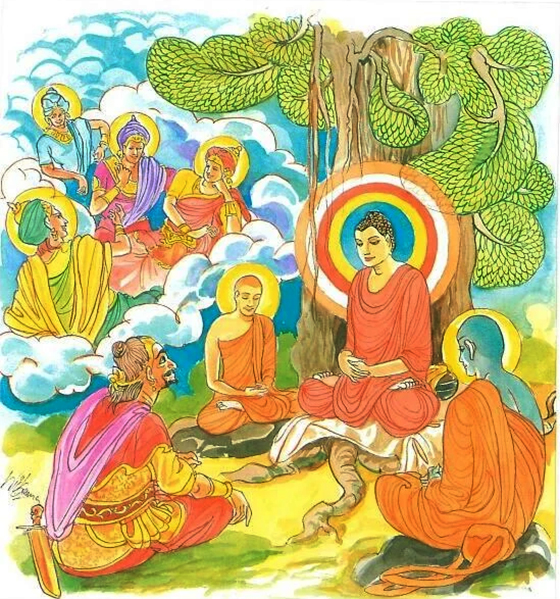
    The Story of Sakka

    While residing at the village of Veluva, the Buddha uttered Verses (206), (207) and (208) of this book, with reference to Sakka, king of the devas.

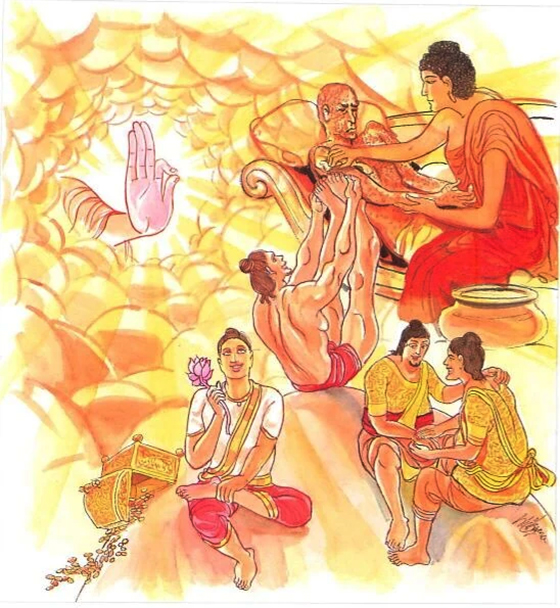
    About ten months before the Buddha realized parinibbana, the Buddha was spending the vassa at Veluva village near Vesali. While he was staying there, he suffered from dysentery. When Sakka learned that the Buddha was ailing, he came to Veluva village so that he could personally nurse the Buddha during his sickness. The Buddha told him not to worry about his health as there were many bhikkhus near him; but Sakka did not listen to him and kept on nursing the Buddha until he recovered.

    The bhikkhus were surprised and awe-struck to find Sakka himself attending on the Buddha. When the Buddha heard their remarks he said, “Bhikkhus! There is nothing surprising about Sakka’s love and devotion to me. Once, when the former Sakka was growing old and was about to pass away, he came to see me. Then, I expounded the Dhamma to him. While listening to the Dhamma, he attained Sotapatti Fruition; then he passed away and was reborn as the present Sakka. All these happened to him simply because he listened to the Dhamma expounded by me. Indeed, bhikkhus, it is good to see the Noble Ones (ariyas); it is a pleasure to live with them; to live with fools is, indeed, painful.” Continue reading

  5. The Story of Thera Tissa

    Comment

    Verse 205: Having had the taste of solitude and the taste of Perfect Peace of Nibbana, one who drinks in the joy of the essence of the Dhamma is free from fear and evil.

    The Story of Thera Tissa

    The Buddha uttered Verse (205) of this book at Vesali, with reference to Thera Tissa.

    When the Buddha declared that in four months’ time he would realize parinibbana, many puthujjana bhikkhus were apprehensive. They were at a loss and did not know what to do, and so they kept close to the Buddha. But Thera Tissa, having resolved that he would attain arahatship in the life-time of the Buddha did not go to him, but left for a secluded place to practise meditation. Other bhikkhus, not understanding his behaviour, took him to the Buddha and said, “Venerable Sir, this bhikkhu does not seem to cherish and honour you; he only keeps to himself instead of coming to your presence.” Thera Tissa then explained to them that he was striving hard to attain arahatship before the Buddha realized parinibbana, and that was the only reason why he had not come to see the Buddha.

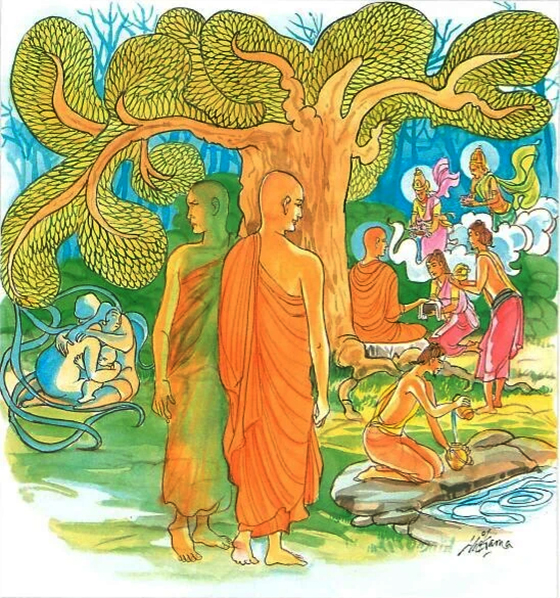
    Having heard his explanation, the Buddha said to the bhikkhus, “Bhikkhus! Those who love and respect me should act like Tissa. You are not paying homage to me by just offering me flowers, perfumes and incense. You pay homage to me only by practising the Lokuttara Dhamma, i.e., Insight Meditation.” Continue reading

  6. The Story of King Pasenadi of Kosala

    Comment

    Verse 204: Health is the greatest gift, contentment is the greatest wealth, a trusted friend is the best relative, Nibbana is the greatest bliss.

    1. vissasaparama: vissasa + parama: vissasa here means trust, also interpreted as intimacy.

    The Story of King Pasenadi of Kosala

    While residing at the Jetavana monastery, the Buddha uttered Verse (204) of this book, with reference to King Pasenadi of Kosala.

    One day, King Pasenadi of Kosala went to the Jetavana monastery after having his full morning meal. It was said that the king had eaten one quarter basket (about half a bushel) of rice with meat curry on that day; so while listening to the Buddha’s discourse he felt very sleepy and was nodding most of the time. Seeing him nodding, the Buddha advised him to take a little less rice everyday and to decrease the amount on a sliding scale to the minimum of one-sixteenth part of the original amount he was taking. The king did as he was told and found that by eating less he became thin, but he felt very much lighter and enjoyed much better health. When he told the Buddha about this, the Buddha said to him, “O king! Health is a great boon; contentment is a great wealth; a close and trusted friend is the best relative; Nibbana is the greatest bliss.” Continue reading

  7. The Story of a Lay-Disciple

    Comment

    Verse 203: Hunger is the greatest ailment, khandhas are the greatest ill. The wise, knowing them as they really are, realize Nibbana, the greatest bliss.

    The Story of a Lay-Disciple

    The Buddha uttered Verse (203) of this book at the village of Alavi, with reference to a lay-disciple.

    One day, the Buddha saw in his vision that a poor man would attain Sotapatti Fruition at the village of Alavi. So he went to that village, which was thirty yojanas away from Savatthi. It so happened that on that very day the man lost his ox. So, he had to be looking for the ox. Meanwhile, alms-food was being offered to the Buddha and his disciples in a house in the village of Alavi. After the meal, people got ready to listen to the Buddha’s discourse; but the Buddha waited for the young man. Finally, having found his ox, the man came running to the house where the Buddha was. The man was tired and hungry, so the Buddha directed the donors to offer food to him. Only when the man had been fed, the Buddha gave a discourse, expounding the Dhamma step by step and finally leading to the Four Noble Truths. The lay-disciple attained Sotapatti Fruition at the end of the discourse.

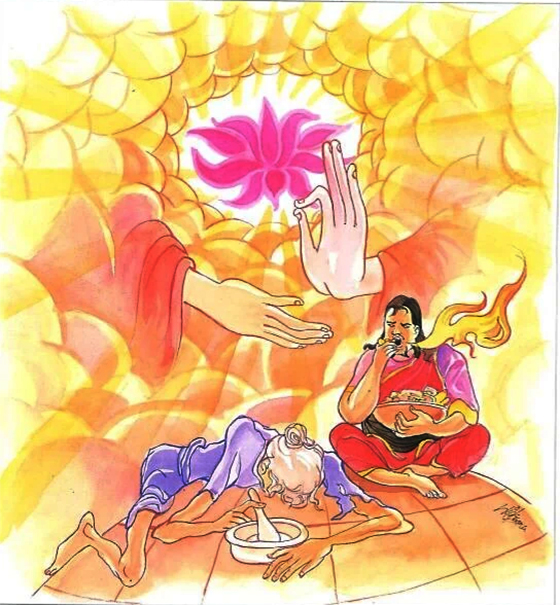
    Afterwards, the Buddha and his disciples returned to the Jetavana monastery. On the way, the bhikkhus remarked that it was so surprising that the Buddha should have directed those people to feed the young man before he gave the discourse. On hearing their remarks, the Buddha said, “Bhikkhus! What you said is true, but you do not understand that I have come here, all this distance of thirty yojanas, because I knew that he was in a fitting condition to take in the Dhamma. If he were feeling very hungry, the pangs of hunger might have prevented him from taking in the Dhamma fully. That man had been out looking for his ox the whole morning, and was very tired and also very hungry. Bhikkhus, after all, there is no ailment which is so difficult to bear as hunger.” Continue reading

  8. The Story of a Young Bride

    Comment

    Verse 202: There is no fire like passion; there is no evil like hatred; there is no ill like (the burden of) khandhas; there is no bliss that surpasses the Perfect Peace (i.e., Nibbana).

    The Story of a Young Bride

    While residing at the Jetavana monastery, the Buddha uttered Verse (202) of this book at the house of a lay-disciple, with reference to a young bride.

    On the day a young woman was to be wedded to a young man, the parents of the bride invited the Buddha and eighty of his disciples for alms-food. Seeing the girl as she moved about the house, helping with the offering of alms-food, the bridegroom was very much excited, and he could hardly attend to the needs of the Buddha and the other bhikkhus. The Buddha knew exactly how the young bridegroom was feeling and also that time was ripe for both the bride and the bridegroom to attain Sotapatti Fruition.

    By his supernormal power, the Buddha willed that the bride would not be visible to the bridegroom. When the young man could no longer see the young woman, he could pay full attention to the Buddha, and his love and respect for the Buddha grew stronger in him. Then the Buddha said to the young man, “O young man, there is no fire like the fire of passion; there is no evil like anger and hatred; there is no ill like the burden of the five aggregates of existence (khandhas); there is no bliss like the Perfect Peace of Nibbana.” Continue reading

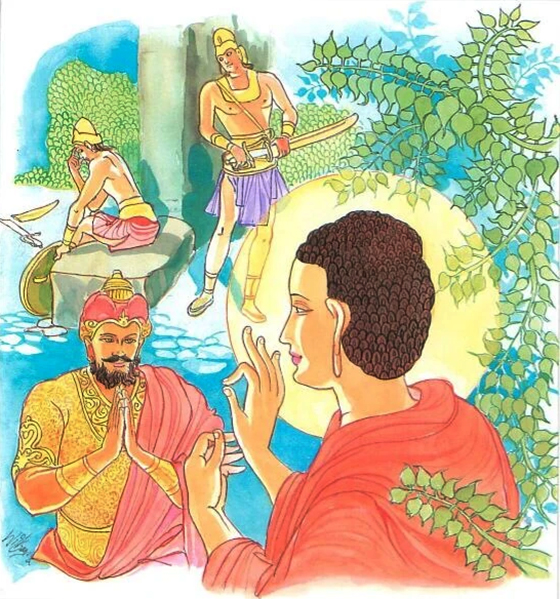
  9. The Story of the Defeat of the King of Kosala

    2

    Verse 201: Conquest begets enmity; the conquered live in misery; the peaceful live happily having renounced conquest and defeat.

    The Story of the Defeat of the King of Kosala

    While residing at the Jetavana monastery, the Buddha uttered Verse (201) of this book, with reference to the King of Kosala who was defeated in battle by Ajatasattu, his own nephew.

    In fighting against Ajatasattu, the King of Kosala was defeated three times. Ajatasattu was the son of King Bimbisara and Queen Vedehi, the sister of the King of Kosala. The King of Kosala was ashamed and very much depressed over his defeat. Thus his lamentation: “What a disgrace! I cannot even conquer this boy who still smells of mother’s milk. It is better that I should die.” Feeling depressed and very much ashamed, the king refused to take food, and kept to his bed. The news about the king’s distress spread like wild fire and when the Buddha came to learn about it, he said, “Bhikkhus! In one who conquers, enmity and hatred increase; one who is defeated suffers pain and distress.” Continue reading

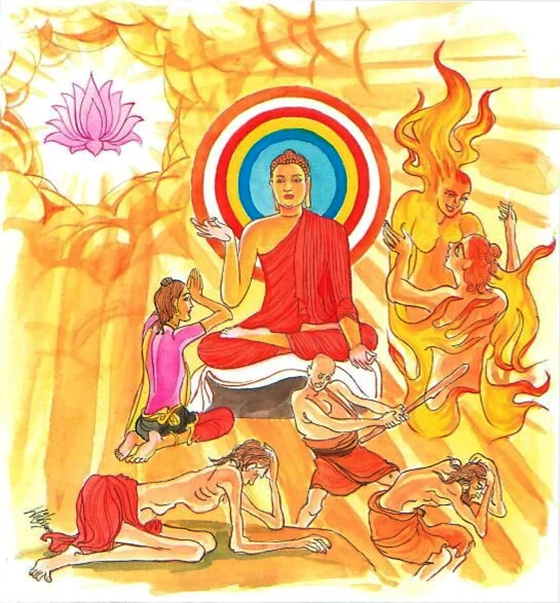
  10. The Story of Mara

    2

    Verse 200: Indeed we live very happily, without any anxiety (i.e., without greed, ill will and ignorance); like the Abhassara brahmas we shall live on delightful satisfaction (piti) as our food.

    1. natthi kincanam: without any anxiety, here it means without greed, ill will and ignorance (raga, dosa and moha).
    2. deva abhassara: Abhassara brahmas are the radiant brahmas of the abode of the second Rupavacara Jhana Brahmaloka.

    The Story of Mara

    The Buddha uttered Verse (200) of this book in a brahmin village known as Pancasala (village of five halls), with reference to Mara.

    On one occasion, the Buddha saw in his vision that five hundred maidens from Pancasala village were due to attain Sotapatti Fruition. So he went to stay near that village. The five hundred maidens went to the riverside to have a bath; after the bath they returned to the village fully dressed up, because it was a festival day. About the same time, the Buddha entered Pancasila village for alms-food but none of the villagers offered him anything because they had been possessed by Mara.

    On his return the Buddha met Mara, who promptly asked him whether he had received much alms-food.

    The Buddha saw the hand of Mara in his failure to get any alms-food on that day and replied, “You wicked Mara! It was you who turned the villagers against me. Because they were possessed by you they did not offer any alms-food to me. Am I not right ?” Mara made no reply to that question, but he thought that it would be fun to entice the Buddha back to the village and get the villagers to insult the Buddha by making fun of him. So he suggested, “O Buddha, why don’t you go back to the village again? This time, you are sure to get some food.” Continue reading

Live & Die for Buddhism

candle

Me & Grandma

My Reflection

This site is a tribute to Buddhism. Buddhism has given me a tremendous inspiration to be who and where I am today. Although I came to America at a very young age, however, I never once forget who I am and where I came from. One thing I know for sure is I was born as a Buddhist, live as a Buddhist and will leave this earth as a Buddhist. I do not believe in superstition. I only believe in karma.

A Handful of Leaves

A Handful of Leaves

Tipitaka: The pali canon (Readings in Theravada Buddhism). A vast body of literature in English translation the texts add up to several thousand printed pages. Most -- but not all -- of the Canon has already been published in English over the years. Although only a small fraction of these texts are available here at Access to Insight, this collection can nonetheless be a very good place to start.

Major Differences

Major Differences in Buddhism

Major Differences in Buddhism: There is no almighty God in Buddhism. There is no one to hand out rewards or punishments on a supposedly Judgement Day ...read more

Problems we face today

jendhamuni pink scarfnature

Of the many problems we face today, some are natural calamities and must be accepted and faced with equanimity. Others, however, are of our own making, created by misunderstanding, and can be corrected...