
1. The Story of the Pacification of the Relatives of the Buddha

    Comment

    Verse 197: Indeed we live very happily, not hating anyone among those who hate; among men who hate we live without hating anyone.

    Verse 198: Indeed we live very happily, in good health among the ailing; among men who are ailing we live in good health.

    Verse 199: Indeed we live very happily, not striving (for sensual pleasures) among these who strive (for them); among those who strive (for them) we live without striving.

    1. aturesu/atura: ailing or ailment; moral ailment is meant here.

    The Story of the Pacification of the Relatives of the Buddha

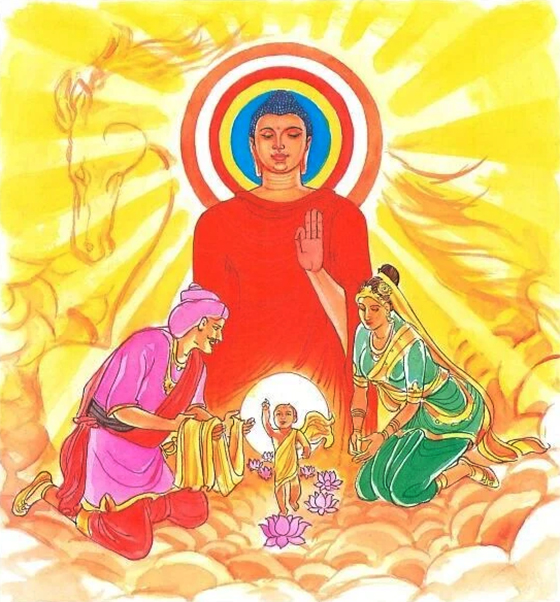
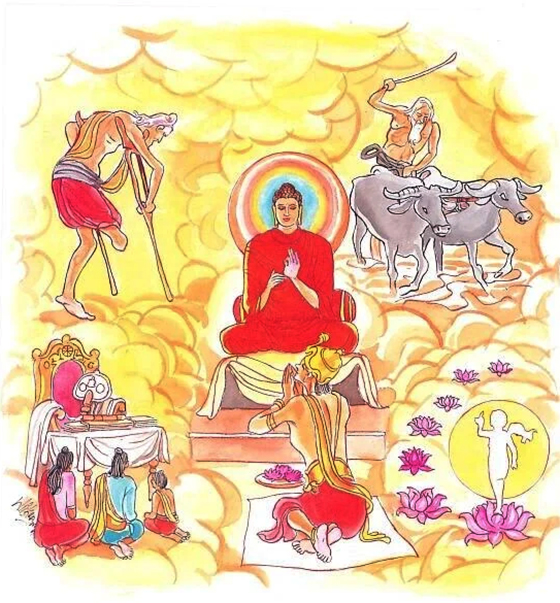
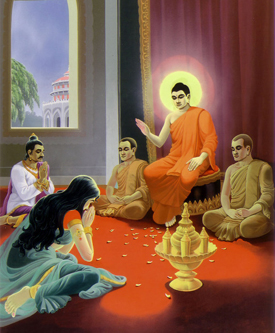
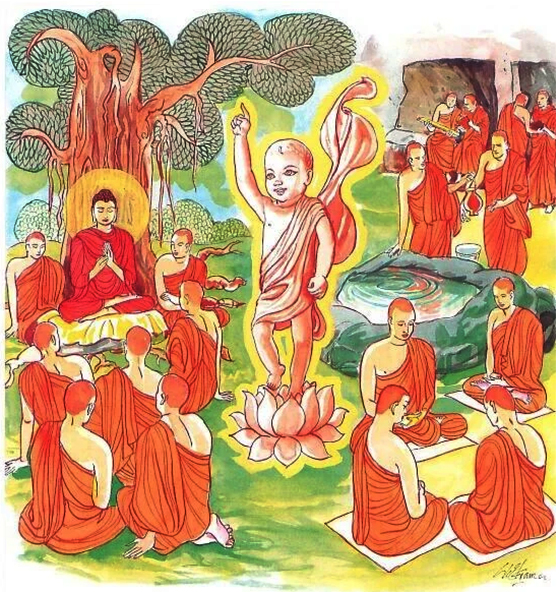
    The Buddha uttered Verse (197) to (199) of this book, in the Sakyan country, with reference to his relatives who were quarrelling over the use of the water from the Rohini river.

    Kapilavatthu the town of the Sakyans and Koliya the town of the Kolyans were situated on either side of the Rohini river. The cultivators of both towns worked the fields watered by the Rohini river. One year, they did not have enough rain and finding that the paddy and other crops were beginning to shrivel up, cultivators on both sides wanted to divert the water from the Rohini river to their own fields. Those living in Koliya said that there was not enough water in the river for both sides, and that if only they could channel the water just once more to their fields that would be enough for the paddy to mature and ripen. On the other hand, people from Kapilavatthu argued that, in that case, they would be denied the use of the water and their crops would surely fail, and they would be compelled to buy from other people. They said that they were not prepared to go carrying their money and valuables to the opposite bank of the river in exchange for food. Continue reading
  2. The Story of the Golden Stupa of Kassapa Buddha

    Comment

    Verse 195: He pays homage to those who are worthy of veneration, whether they are the Buddhas or their disciples who have overcome obstacles (to Insight Development) and have rid themselves of sorrow and lamentation.

    Verse 196: The merit gained by such a person who pays homage to those who have been freed from moral defilements and have nothing to fear, cannot be measured by anyone, as this much or that much.

    1. papancasamatikkante: lit., who have got rid of craving, pride and wrong view, factors lengthening samsara.

    The Story of the Golden Stupa of Kassapa Buddha

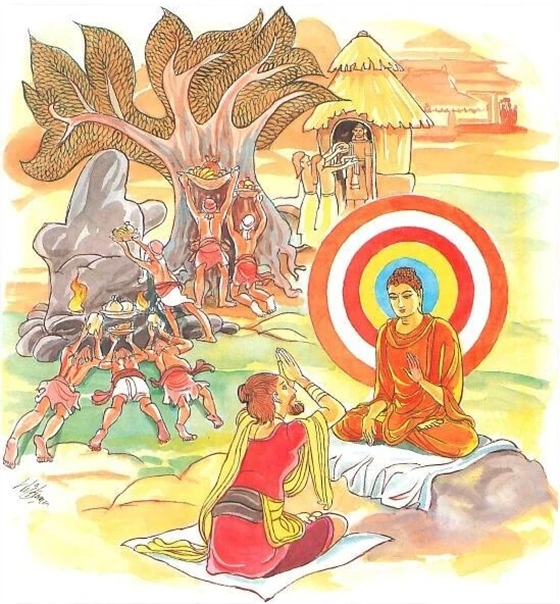
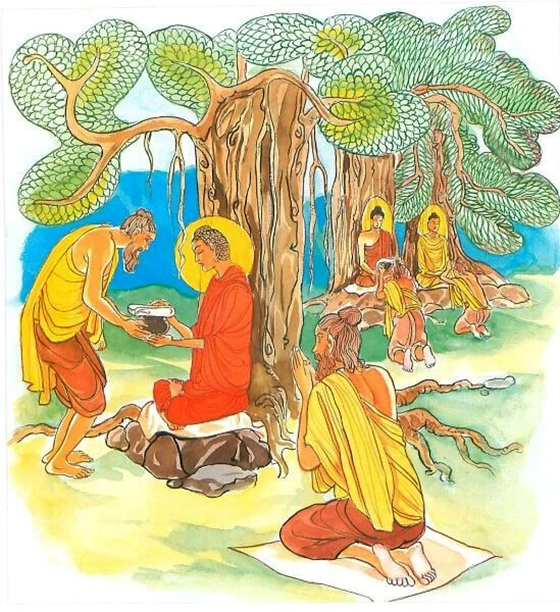
    While travelling from Savatthi to Baranasi, the Buddha uttered Verses (195) and (196) of this book, with reference to a brahmin and the golden stupa of Kassapa Buddha.

    On one occasion, while the Buddha and his followers were on a journey to Baranasi they came to a field where there was a spirit-shrine. Not far from the shrine, a brahmin was ploughing the field; seeing the brahmin the Buddha sent for him. When he arrived, the brahmin made obeisance to the shrine but not to the Buddha. To him the Buddha said, “Brahmin, by paying respect to the shrine you are doing a meritorious deed.” That made the brahmin happy. After thus putting him in a favourable frame of mind, the Buddha, by his supernormal power, brought forth the golden stupa of Kassapa Buddha and let it remain visible in the sky. The Buddha then explained to the brahmin and the other bhikkhus that there were four classes of persons worthy of a stupa. They are: the Buddhas (Tathagatas) who are homage-worthy and perfectly self-enlightened, the Paccekabuddhas, the Ariya disciples, and the Universal Monarchs. He also told them about the three types of stupas erected in honour of these four classes of persons. The stupas where corporeal relics are enshrined are known as Sariradhatu cetiya; the stupas and figures made in the likeness of the above four personages are known as Uddissa cetiya; and the stupas where personal effects like robes, bowls, etc. of those revered personages are enshrined are known as Paribhoga cetiya. The Bodhi tree is also included in the Paribhoga cetiya. The Buddha then stressed the importance of paying homage to those who are worthy of veneration. Continue reading

  3. The Story of Many Bhikkhus

    Comment

    Verse 194: Happy is the arising of a Buddha; happy is the exposition of the Ariya Dhamma; happy is the harmony amongst the Samgha; happy is the practice of those in harmony.

    The Story of Many Bhikkhus

    While residing at the Jetavana monastery, the Buddha uttered Verse (194) of this book, with reference to many bhikkhus.

    Once, five hundred bhikkhus were discussing the question “What constitutes happiness?” These bhikkhus realized that happiness meant different things to different people. Thus, they said, “To some people to have the riches and glory like that of a king’s is happiness, to some people sensual pleasure is happiness, but to others to have good rice cooked with meat is happiness.” While they were talking, the Buddha came in. After learning the subject of their talk, the Buddha said, “Bhikkhus, all the pleasures you have mentioned do not get you out of the round of rebirths. In this world, these constitute happiness: the arising of a Buddha, the opportunity to hear the Teaching of the Sublime Truth, and the harmony amongst the bhikkhus,”

    Then the Buddha spoke in verse as follows:

    Verse 194: Happy is the arising of a Buddha; happy is the exposition of the Ariya Dhamma; happy is the harmony amongst the Samgha; happy is the practice of those in harmony.
    At the end of the discourse the five hundred bhikkhus attained arahatship. Continue reading

  4. The Story of the Question Raised by Thera Ananda

    Comment

    Verse 193: It is hard to find the noblest of men; he is not born everywhere nor in every clan. To whatever clan such a wise man is born, that clan prospers.

    1. purisajanno: According to the Commentary, a Buddha is intended.
    2. sukhamedhati: lit., attains happiness or thrives in happiness.

    The Story of the Question Raised by Thera Ananda

    While residing at the Jetavana monastery, the Buddha uttered Verse (193) of this book, with reference to the question raised by Thera Ananda.

    One day, Thera Ananda pondered thus: “Our Teacher has told us that thoroughbreds of elephants are born only among Chaddanta and Uposatha breeds, that thoroughbreds of horses are born only among the Sindh breed, that thoroughbreds of cattle are born only among the Usabha breed. Thus, he had talked to us only about the thoroughbreds of elephants, horses, and cattle, but not of the noblest of men (purisajanno).”

    After reflecting thus, Thera Ananda went to the Buddha, and put to him the question of the noblest of men. To him the Buddha replied, “Ananda, the noblest of men is not born everywhere, he is born only among Khattiyamahasala and Brahmanamahasala, the wealthy clans of Khattiya and Brahmana.” Continue reading

  5. The Story of Aggidatta

    2

    Verse 188: When threatened with danger, men go to many a refuge, – to mountains and forests, to parks and gardens, and to sacred trees.

    Verse 189: But such a refuge is not a safe refuge, not the best refuge. One is not liberated from all evil consequences of existence (dukkha) for having come to such a refuge.

    Verses 190 & 191: One, who takes refuge in the Buddha, the Dhamma and the Samgha, sees with Magga Insight the Four Noble Truths, viz., Dukkha, the Cause of Dukkha, the Cessation of Dukkha, and the Noble Path of Eight Constituents which leads to the Cessation of Dukkha.

    Verse 192: This, indeed, is the safe refuge; this is the best refuge. Having come to this refuge, one is liberated from all dukkha. Continue reading

  6. The Story of a Dissatisfied Young Bhikkhu

    Comment

    Verses 186 & 187: Not by a shower of coins can sensual desires be satiated; sensual desires give little pleasure and are fraught with evil consequences (dukkha). Knowing this, the wise man, who is the disciple of the Buddha, does not find delight even in the pleasures of the devas, but rejoices in the cessation of craving (i.e., Nibbana).

    The Story of a Dissatisfied Young Bhikkhu

    While residing at the Jetavana monastery, the Buddha uttered Verses (186) and (187) of this book, with reference to a young bhikkhu who was unhappy with his life as a bhikkhu.

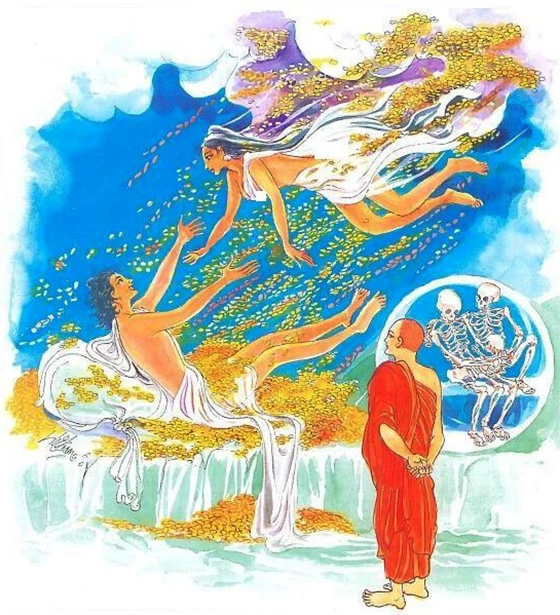
    Once, there was a young bhikkhu at the Jetavana monastery. One day his teacher sent him to another monastery to study. While he was away, his father became seriously ill and died without seeing him. But his father left for him one hundred kahapanas with his brother, the boy’s uncle. On his return, his uncle told him about his father’s death and about the one hundred kahapanas left to him. At first, he said that he had no need of the money. Later, he thought that it might be better to return to lay-life, and as a result, he got dissatisfied with the life of a bhikkhu. Gradually, he began to lose interest in his life and was also losing weight. When other bhikkhus knew about this, they took him to the Buddha.

    The Buddha asked him whether it was true that he was feeling unhappy with his life as a bhikkhu and whether he had any capital to start the life of a layman. He answered that it was true and that be had one hundred kahapanas to start his life with. Then the Buddha explained to him that he would need to get food, clothing, household utensils, two oxen, ploughs, pickaxes, knives, etc., so that his one hundred in cash would hardly meet the expenses. The Buddha then told him that for human beings there could never be enough, not even for Universal Monarchs who could call for a shower of coins or gems or any amount of wealth and treasures at any moment. Further, the Buddha related the story of Mandatu, the Universal Monarch, who enjoyed the glory of the devas both in the Catumaharajika and Tavatimsa realms for a long time. After spending a long time in Tavatimsa, one day, Mandatu wished that he were the sole ruler of Tavatimsa, instead of sharing it with Sakka. But this time, his wish could not be fulfilled and instantly he became old and decrepit; he returned to the human world and died soon after. Continue reading

  7. The Story of the Question Raised by Thera Ananda

    Comment

    Verse 183: Not to do evil, to cultivate merit, to purify one’s mind – this is the Teaching of the Buddhas.

    Verse 184: The best moral practice is patience and forbearance; “Nibbana is Supreme”, said the Buddhas. A bhikkhu does not harm others; one who harms others is not a bhikkhu.

    Verse 185: Not to revile, not to do any harm, to practise restraint according to the Fundamental Instructions for the bhikkhus, to be moderate in taking food, to dwell in a secluded place, to devote oneself to higher concentration – this is the Teaching of the Buddhas.

    The Story of the Question Raised by Thera Ananda

    While residing at the Jetavana monastery, the Buddha uttered Verses (183), (184) and (185) of this book, with reference to the question raised by Thera Ananda regarding Fundamental Instructions to bhikkhus by the preceding Buddhas.

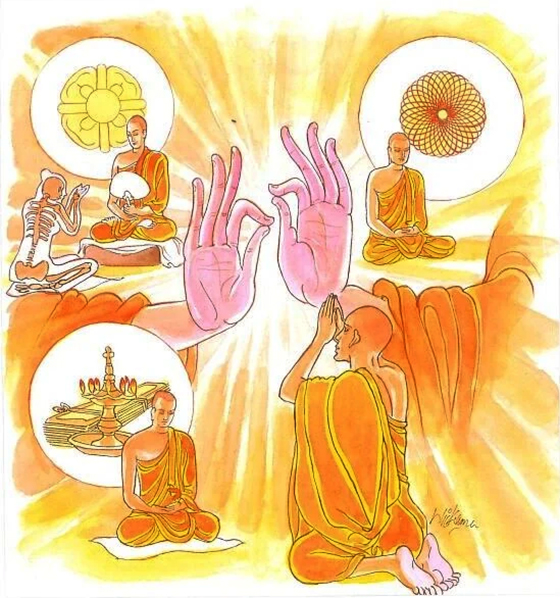
    On one occasion, Thera Ananda asked the Buddha whether the Fundamental Instructions to bhikkhus given by the preceding Buddhas were the same as those of the Buddha himself. To him the Buddha replied that the instructions given by all the Buddhas are as given in the following verses: Continue reading

  8. The Story of Erakapatta the Naga King

    Comment

    Verse 182: Hard to gain is birth as man; hard is the life of mortals; hard to get is the opportunity of hearing the Ariya Dhamma (Teaching of the Buddhas); hard it is for a Buddha to appear.

    The Story of Erakapatta the Naga King

    While residing near Baranasi the Buddha uttered Verse (182) of this book, with reference to Erakapatta, a king of nagas (dragons).

    Once there was a naga king by the name of Erakapatta. In one of his past existences during the time of Kassapa Buddha he had been a bhikkhu for a long time. Through worry (kukkucca) over a minor offence he had committed during that time, he was reborn as a naga. As a naga, he waited for the appearance of a Buddha. Erakapatta had a very beautiful daughter, and he made use of her as a means of finding the Buddha. He made it known that whoever could answer her questions could claim her for a wife. Twice every month, Erakapatta made her dance in the open and sing out her questions. Many suitors came to answer her questions hoping to claim her, but no one could give the correct answer.

    One day, the Buddha saw a youth named Uttara in his vision. He also knew that the youth would attain Sotapatti Fruition in connection with the questions put by the daughter of Erakapatta the naga. By then the youth was already on his way to see Erakapatta’s daughter. The Buddha stopped him and taught him how to answer the questions. While he was being taught, Uttara attained Sotapatti Fruition. Now that Uttara had attained Sotapatti Fruition, he had no desire for the naga princess. However, Uttara still went to answer the questions for the benefit of numerous other beings. Continue reading

  9. The Story of the Buddha’s Return from the Tavatimsa Deva World

    Comment

    Verse 181: The wise who practise jhana concentration and Insight Meditation take delight in the peace of liberation from sensual pleasures and moral defilements. Such wise and mindful ones, who truly comprehend the Four Noble Truths (i.e., Arahats and Buddhas) are held dear also by the devas.

    The Story of the Buddha’s Return from the Tavatimsa Deva World

    On return from the Tavatimsa deva world, the Buddha uttered Verse (181) of this book at Sankassanagara, in reply to Thera Sariputta’s words of welcome.

    On one occasion, while at Savatthi, the Buddha performed the Miracle of the Pairs in answer to the challenge of the ascetics of various sects. After this, the Buddha went to the Tavatimsa deva world; his mother who had been reborn in the Tusita deva world as a deva known as Santusita also came to the Tavatimsa deva world. There the Buddha expounded the Abhidhamma to the devas and the brahmas throughout the three months of the vassa. As a result, Santusita deva attained Sotapatti Fruition; so did numerous other devas and brahmas.

    During that period Thera Sariputta spent the vassa at Sankassanagara, thirty yojanas away from Savatthi. During his stay there, as regularly instructed by the Buddha, he taught the Abhidhamma to the five hundred bhikkhus staying with him and covered the whole course by the end of the vassa.

    Towards the end of the vassa, Thera Maha Moggalana went to the Tavatimsa deva world to see the Buddha. Then, he was told that the Buddha would return to the human world on the full moon day at the end of the vassa to the place where Thera Sariputta was spending the vassa. Continue reading

  10. The Story of the Three Daughters of Mara

    Comment

    Verse 179: The Buddha, whose conquest (of moral defilements) is complete, in whom there cannot arise any further defilements in this world, that Buddha of infinite range of wisdom, who is trackless, – by what track will you lead him?

    Verse 180: The Buddha, in whom there is no craving, which like a net would bring him back to any existence (in samsara), that Buddha of infinite range of wisdom, who is trackless, – by what track will you lead him?

    1. jitam navajiyati: ‘the conquest is complete’ means there is no need for further conquests as there are no more moral defilements to be conquered.
    2. jitam yassa no’yati koci loke: lit., whose conquered defilements cannot be followed by any further defilements in this world.

    3. anantagocaram: The range of wisdom of the Buddha is infinite by reason of his omniscience, Sabbannuta nana. (The Commentary)

    4. apadam: lit., ‘trackless’. The Buddha, being free from conditions of rebirth, such as craving, clinging, passion, etc., his track or passage through samsara has come to an end. (The Com.)

    [The same idea is conveyed in verses 92 and 93 which express the idea that the arahat passes away, leaving no more trace of existence than a bird leaves its passage through the air.]

    1. kena padena nessatha: lit., by what track will you lead him? It means he cannot be lured by any temptation whatsoever. Continue reading

Live & Die for Buddhism

candle

Me & Grandma

My Reflection

This site is a tribute to Buddhism. Buddhism has given me a tremendous inspiration to be who and where I am today. Although I came to America at a very young age, however, I never once forget who I am and where I came from. One thing I know for sure is I was born as a Buddhist, live as a Buddhist and will leave this earth as a Buddhist. I do not believe in superstition. I only believe in karma.

A Handful of Leaves

A Handful of Leaves

Tipitaka: The pali canon (Readings in Theravada Buddhism). A vast body of literature in English translation the texts add up to several thousand printed pages. Most -- but not all -- of the Canon has already been published in English over the years. Although only a small fraction of these texts are available here at Access to Insight, this collection can nonetheless be a very good place to start.

Major Differences

Major Differences in Buddhism

Major Differences in Buddhism: There is no almighty God in Buddhism. There is no one to hand out rewards or punishments on a supposedly Judgement Day ...read more

Problems we face today

jendhamuni pink scarfnature

Of the many problems we face today, some are natural calamities and must be accepted and faced with equanimity. Others, however, are of our own making, created by misunderstanding, and can be corrected...