

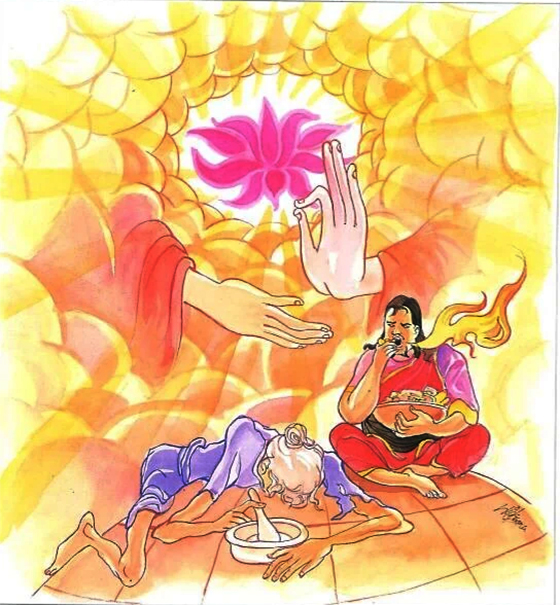
Verse 203: Hunger is the greatest ailment, khandhas are the greatest ill. The wise, knowing them as they really are, realize Nibbana, the greatest bliss.
The Story of a Lay-Disciple
The Buddha uttered Verse (203) of this book at the village of Alavi, with reference to a lay-disciple.
One day, the Buddha saw in his vision that a poor man would attain Sotapatti Fruition at the village of Alavi. So he went to that village, which was thirty yojanas away from Savatthi. It so happened that on that very day the man lost his ox. So, he had to be looking for the ox. Meanwhile, alms-food was being offered to the Buddha and his disciples in a house in the village of Alavi. After the meal, people got ready to listen to the Buddha’s discourse; but the Buddha waited for the young man. Finally, having found his ox, the man came running to the house where the Buddha was. The man was tired and hungry, so the Buddha directed the donors to offer food to him. Only when the man had been fed, the Buddha gave a discourse, expounding the Dhamma step by step and finally leading to the Four Noble Truths. The lay-disciple attained Sotapatti Fruition at the end of the discourse.
Afterwards, the Buddha and his disciples returned to the Jetavana monastery. On the way, the bhikkhus remarked that it was so surprising that the Buddha should have directed those people to feed the young man before he gave the discourse. On hearing their remarks, the Buddha said, “Bhikkhus! What you said is true, but you do not understand that I have come here, all this distance of thirty yojanas, because I knew that he was in a fitting condition to take in the Dhamma. If he were feeling very hungry, the pangs of hunger might have prevented him from taking in the Dhamma fully. That man had been out looking for his ox the whole morning, and was very tired and also very hungry. Bhikkhus, after all, there is no ailment which is so difficult to bear as hunger.”
Then the Buddha spoke in verse as follows:
Verse 203: Hunger is the greatest ailment, khandhas are the greatest ill. The wise, knowing them as they really are, realize Nibbana, the greatest bliss.
Dhammapada Verse 203
Eka Upasaka Vatthu
Jighacchaparama roga
sankharaparama dukha
etam natva yathabhutam
nibbanam paramam sukham.
Source: Tipitaka



Add a comment