

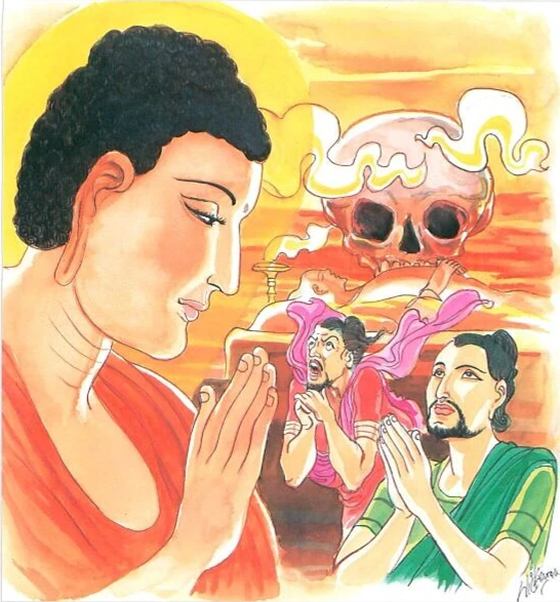
Verse 212: Affection begets sorrow, affection begets fear. For him who is free from affection there is no sorrow; how can there be fear for him?
The Story of a Rich Householder
While residing at the Jetavana monastery, the Buddha uttered Verse (212) of this book, with reference to a rich householder who had lost his son.
Once, a householder was feeling very distressed over the death of his son. He often went to the cemetery and wept there. Early one morning, the Buddha saw the rich householder in his vision. So, taking a bhikkhu along with him, the Buddha went to the house of that man. There, he asked the man why he was feeling so unhappy. Then, the man related to the Buddha about the death of his son and about the pain and sorrow he was suffering. To him the Buddha said, “My disciple, death does not occur only in one place. All beings that are born must die one day; indeed, life ends in death. You must ever be mindful of the fact that life ends in death. Do not imagine that only your beloved son is subject to death. Do not be so distressed or be so shaken. Sorrow and fear arise out of affection.”
Then the Buddha spoke in verse as follows:
Verse 212: Affection begets sorrow, affection begets fear. For him who is free from affection there is no sorrow; how can there be fear for him?
At the end of the discourse, the rich householder attained Sotapatti Fruition.
Dhammapada Verse 212
Annatarakutumbika Vatthu
Piyato jayati soko
piyato jayati bhayam
piyato vippamuttassa
natthi soko kuto bhayam.
Source: Tipitaka



Add a comment