

Verse 206: It is good to see the Noble Ones (ariyas); to live with them is always a pleasure; not seeing fools is also always a pleasure.
Verse 207: He who walks in the company of fools has to grieve for a long time. Association with fools is ever painful, as living with an enemy; association with the wise is a pleasure, as living with relatives.
Verse 208: Therefore one should follow a resolute, intelligent, learned, persevering and dutiful ariya; follow such a virtuous and wise man, as the moon follows the path of the stars.
The Story of Sakka
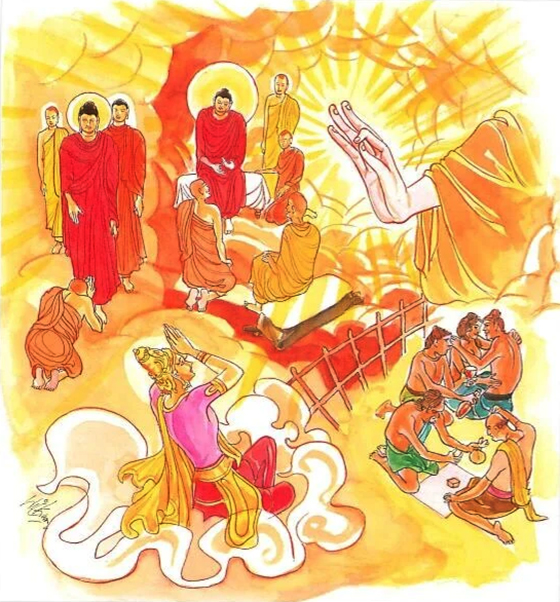
While residing at the village of Veluva, the Buddha uttered Verses (206), (207) and (208) of this book, with reference to Sakka, king of the devas.
About ten months before the Buddha realized parinibbana, the Buddha was spending the vassa at Veluva village near Vesali. While he was staying there, he suffered from dysentery. When Sakka learned that the Buddha was ailing, he came to Veluva village so that he could personally nurse the Buddha during his sickness. The Buddha told him not to worry about his health as there were many bhikkhus near him; but Sakka did not listen to him and kept on nursing the Buddha until he recovered.
The bhikkhus were surprised and awe-struck to find Sakka himself attending on the Buddha. When the Buddha heard their remarks he said, “Bhikkhus! There is nothing surprising about Sakka’s love and devotion to me. Once, when the former Sakka was growing old and was about to pass away, he came to see me. Then, I expounded the Dhamma to him. While listening to the Dhamma, he attained Sotapatti Fruition; then he passed away and was reborn as the present Sakka. All these happened to him simply because he listened to the Dhamma expounded by me. Indeed, bhikkhus, it is good to see the Noble Ones (ariyas); it is a pleasure to live with them; to live with fools is, indeed, painful.”
Then the Buddha spoke in verse as follows:
Verse 206: It is good to see the Noble Ones (ariyas); to live with them is always a pleasure; not seeing fools is also always a pleasure.
Verse 207: He who walks in the company of fools has to grieve for a long time. Association with fools is ever painful, as living with an enemy; association with the wise is a pleasure, as living with relatives.
Verse 208: Therefore one should follow a resolute, intelligent, learned, persevering and dutiful ariya; follow such a virtuous and wise man, as the moon follows the path of the stars.
End of Chapter Fifteen: Happiness (Sukhavagga)
Dhammapada Verses 206, 207 and 208
Sakka Vatthu
Sahu dassanamariyanam
sannivaso sada sukho
adassanena balanam
niccameva sukhi siya.
Balasangatacari hi
dighamaddhana socati
dukkho balehi samvaso
amitteneva sabbada
dhiro ca sukhasamvaso
natinam va samagamo.
Tasma hi
dhiranca pannanca bahussutanca
dhorayhasilam vatavantamariyam
tam tadisam sappurisam sumedham
bhajetha nakkhattapathamva candima.
Source: Tipitaka



Add a comment