1. Before I was a Mom

    Comment

    Before I was a Mom –
    I slept as late as I wanted and never worried about how late I got into bed.
    I brushed my hair and my teeth everyday.

    Before I was a Mom –
    I cleaned my house each day. I never tripped over toys or forgot words to a lullaby.
    I didn’t worry whether or not my plants were poisonous.
    I never thought about immunizations.

    Before I was a Mom –
    I had never been puked on – Pooped on – Spit on – Chewed on, or Peed on.
    I had complete control of my mind and My thoughts. I slept all night. Continue reading

  2. Smiling heart

    4

    Nothing shakes the smiling heart.  ~ Santosh Kalwar

  3. Wear a big smile

    Comment

    People seldom notice old clothes if you wear a big smile. ~Lee Mildon


  4. Kneeling in the Snow

    Comment

    Transcribed talks by Ratnaghosa
    Talk two of six on patience or kshanti

    The title of this talk comes from an image that stuck in my mind after reading a book several years ago. I don’t recall the title of the book now. It was written by a Dutch man and was about his experiences of living in a Zen monastery in Japan. One of the things he mentioned was the tradition of making newcomers wait outside for a few days as a sort of test of their aspiration and commitment to join the monastery.

    They would have to hold themselves in a particular position, probably more like squatting than kneeling, and just wait. Sometimes the Abbot would send someone out to chase them away.

    This was a compassionate act to give them respite from their uncomfortable position, although the novices wouldn’t necessarily know that. So if they really wanted to join the monastery badly enough, they would just wait – kneeling in the snow – as I’ve put it (perhaps fancifully). They would be patient.

    Can you imagine the dark, angry, resentful thoughts that might assail you if you were put in that position? Even if you knew it was a ritual of waiting – you would still find it hard to put up with. So the ability to exercise patient endurance was seen as a necessary prerequisite for monastic life. It’s as if the Zen monks are saying “If you don’t have patience, if you can’t endure, well, don’t bother, because you won’t get very far”. Continue reading

  5. And Grandma’s too…

    Comment
     unknown

    Grandma in Cambodia

    While we honor all our mothers
    with words of love and praise.
    While we tell about their goodness
    and their kind and loving ways.
    We should also think of Grandma,
    she’s a mother too, you see….
    For she mothered my dear mother
    as my mother mothers me.

    ~Author Unknown

  6. The Antidote to Snakebite

    Comment

    Transcribed talks by Ratnaghosa
    Talk one of six on patience or kshanti

    In the novel “Kim” by Rudyard Kipling, one of the main characters is a Tibetan Lama. Kim becomes his disciple or chela and the Lama, who is an artist, paints a picture of the Wheel of Life so that he can use it to teach the Dharma to Kim.

    “When the shadows shortened and the lama leaned more heavily upon Kim, there was always the Wheel of Life to draw forth, to hold flat under wiped stones, and with a long straw to expound cycle by cycle. Here sat the Gods on high – and they were dreams of dreams. Here was our Heaven and the world of the demi-Gods – horsemen fighting among the hills. Here were the agonies done upon the beasts, souls ascending or descending the ladder and therefore not to be interfered with. Here were the Hells, hot and cold, and the abodes of tormented ghosts. Let the chela study the troubles that come forth from overeating – bloated stomach and burning bowels. Obediently then, with bowed head and brown finger alert to follow the pointer, did the chela study.”(1) Continue reading

  7. Maha Jayamangala Gatha

    1

    1. The Great Merciful Lord, for the good of all living beings, practiced all Perfections
      and attained supreme Enlightenment. By these true words may joyous victory be mine.
    2. He who enhanced the happiness of the Sakyas who was victorious at the foot of the Bodhi-Tree.
      Likewise may there be victory to me, and may I ever be blessed.

    3. I revere, the Buddha-jewel highest balm and best, ever beneficial to gods and men.
      By that Buddha’s glory safely, may all obstacles and sufferings ceased.

    4. I revere the Dhamma-jewel, highest balm and best, that cools down the heat.
      By the power of the Dhamma safely, may all obstacles and fears cease.

    5. I revere the Sangha-jewel, highest balm and best, worthy of offerings worthy of hospitality.
      By the power of that Sangha safely may all my obstacles pass away! Continue reading

  8. The Tale of the Two Parrots

    Comment

    This is a story of two parrots, who loved to travel far and wide in search of food and visit new places. These two beautiful birds were brothers named Radha and Potthapada. Once, they entered the palace gardens and were caught in a trap laid for birds. Both Radha and Potthapada were brought before the king, who just could not keep his eyes off the stunning birds. The king ordered his men that the birds be kept in a special cage made of gold. They were fed the choicest foods everyday.

    Radha and Potthapada were the toast of the king’s palace. Royal guests would stand by the golden cage and admire the birds. Life was very comfortable for them until the day a huge ape was brought to the palace. The ugly ape was named Kalabahu. Soon, all attention that was reserved for the parrots was now Kalabahu’s. People had not seen such a huge ape before. Kalabahu became the center of attraction of all the royal guests and palace officials. They would pour in to have a good look at the ape and his antics that made everyone roar with laughter. As a result, both the parrots started feeling neglected. Nobody cared whether they were fed on time or not.

    Potthapada, the younger of the two parrots, was deeply hurt. He confided in his elder brother, “Let us leave here and go elsewhere. Nobody cares for us anymore.” Radha, wiser of the two, replied, “Potthapada, my brother, do not feel so sad. Attention, praise and blame, and honor and dishonor are temporary facets of life. Soon, people will get tired of the ape’s antics and know your true worth.”

    And, sure enough, people started disliking the ape, as he began misbehaving and fooling around a bit too much. The king also found his acts offensive, and ordered Kalabahu to be sent back to the forest. People started paying all their attention to the well-behaved and beautiful parrots once again. And, did you know who the intelligent Radha was? He was Buddha in one of his earlier births.

    Moral: True worth and ability are always given their due ultimately.

    Source: http://www.jatakkatha.com

  9. Almonds nutrition facts

    Comment


    Wonderfully delicious, almonds have long been revered as symbol of wellness and health. The nuts are enriched with many health-benefiting nutrients that are essential for optimum health.

    Botanically, they are the fruits from species of tree belonging to the family of Rosaceae, of Genus: Prunus. Scientific name: Prunus dulcis.

    Almond tree is a small deciduous tree, native to mineral rich West-Asian mountain ranges that provide optimum environment for their growth. In recent years, it is being cultivated in many regions of the world as an important commercial crop.

    During each spring season, the tree bears whitish-pink flowers that ultimately become fruits by autumn.

    In structure; the fruit is a drupe; a single seed, known as ‘almond nut’ is actually enclosed inside the stony hard shell. Almonds feature oval to conical in shape, brown in color, measuring about 2 cm in length and 1 cm in breadth and weigh about 1 to 1.5 g. Continue reading

  10. Training this Mind

    Comment

    A Dhammatalk by Ajahn Chah

    Training this mind… actually there’s nothing much to this mind. It’s simply radiant in and of itself. It’s naturally peaceful. Why the mind doesn’t feel peaceful right now is because it gets lost in its own moods. There’s nothing to mind itself. It simply abides in its natural state, that’s all. That sometimes the mind feels peaceful and other times not peaceful is because it has been tricked by these moods. The untrained mind lacks wisdom. It’s foolish. Moods come and trick it into feeling pleasure one minute and suffering the next. Happiness then sadness. But the natural state of a person’s mind isn’t one of happiness or sadness. This experience of happiness and sadness is not the actual mind itself, but just these moods which have tricked it. The mind gets lost, carried away by these moods with no idea what’s happening. And as a result, we experience pleasure and pain accordingly, because the mind has not been trained yet. It still isn’t very clever. And we go on thinking that it’s our mind which is suffering or our mind which is happy, when actually it’s just lost in its various moods. Continue reading


Live & Die for Buddhism

candle

Khmer Tipitaka 1 – 110

 ព្រះត្រៃបិដក

ព្រះត្រៃបិដក ប្រែថា កញ្រ្ចែង ឬ ល្អី​ ៣ សម្រាប់ដាក់ផ្ទុកពាក្យពេចន៍នៃព្រះសម្មាសម្ពុទ្ធ

The Tipitaka or Pali canon, is the collection of primary Pali language texts which form the doctrinal foundation of Theravada Buddhism. The three divisions of the Tipitaka are: Vinaya Pitaka, Sutta Pitaka, Abhidhamma Pitaka.

Maha Ghosananda

Maha Ghosananda

Supreme Patriarch of Cambodian Buddhism (5/23/1913 - 3/12/07). Forever in my heart...

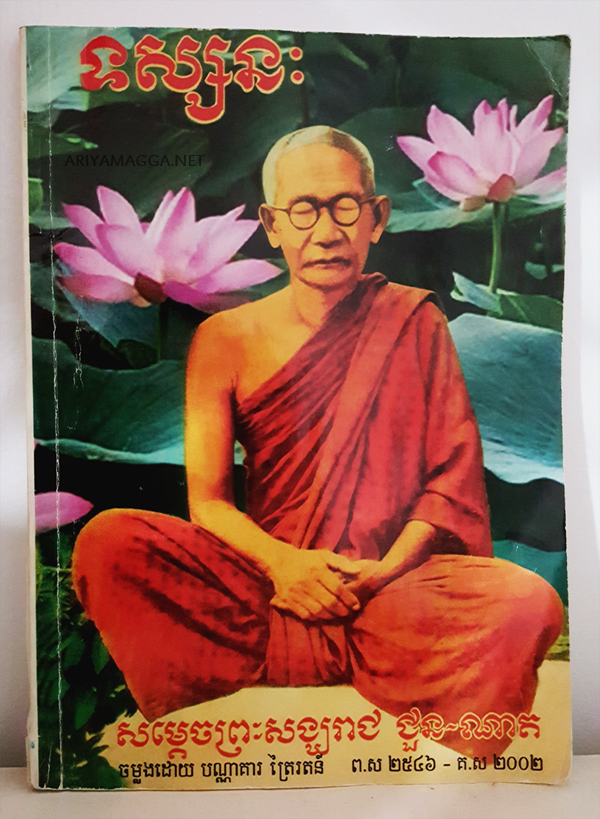
Samdech Chuon Nath

My reflection

វចនានុក្រមសម្តេចសង្ឃ ជួន ណាត
Desktop version

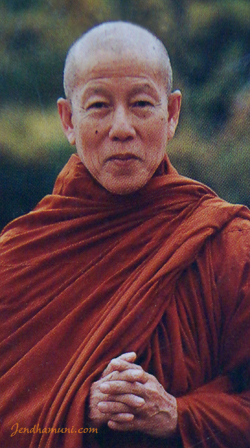
Listen to Khmer literature and Dhamma talk by His Holiness Jotannano Chuon Nath, Supreme Patriarch of Cambodia Buddhism.

Shantidevas’ Bodhisattva vows

My reflection

Should anyone wish to ridicule me and make me an object of jest and scorn why should I possibly care if I have dedicated myself to others?

Let them do as they wish with me so long as it does not harm them. May no one who encounters me ever have an insignificant contact.

Regardless whether those whom I meet respond towards me with anger or faith, may the mere fact of our meeting contribute to the fulfilment of their wishes.

May the slander, harm and all forms of abuse that anyone should direct towards me act as a cause of their enlightenment.

As a solid rock is not shaken by the wind, so the wise are not shaken by blame and praise. As a deep lake is clear and calm, so the wise become tranquil after they listened to the truth…

Good people walk on regardless of what happens to them. Good people do not babble on about their desires. Whether touched by happiness or by sorrow, the wise never appear elated or depressed. ~The Dhammapada

Hermit of Tbeng Mountain

Sachjang Phnom Tbeng សច្ចំ​​ ភ្នំត្បែង is a very long and interesting story written by Mr. Chhea Sokoan, read by Jendhamuni Sos. You can click on the links below to listen. Part 1 | Part 2

Beauty in nature

A beautiful object has no intrinsic quality that is good for the mind, nor an ugly object any intrinsic power to harm it. Beautiful and ugly are just projections of the mind. The ability to cause happiness or suffering is not a property of the outer object itself. For example, the sight of a particular individual can cause happiness to one person and suffering to another. It is the mind that attributes such qualities to the perceived object. — Dilgo Khyentse Rinpoche

Nature is loved by what is best in us. The sky, the mountain, the tree, the animal, give us a delight in and for themselves. — Ralph Waldo Emerson


Our journey for peace
begins today and every day.
Each step is a prayer,
Each step is a meditation,
Each step will build a bridge.

—​​​ Maha Ghosananda