1. What the Buddha said about metta
    Comment

    Bhikkhus, whatever kinds of worldly merit there are, all are not worth one 16th part of the release of mind by universal friendliness; in shining, glowing, beaming & radiance the release of mind by universal friendliness far excels & surpasses them all. Itivuttaka 27

    As a mother even with own life protects her only child, so should one cultivate immeasurable loving-kindness towards all living beings. The Metta Sutta

    He who both day and night takes delight in harmlessness sharing love with all that live, finds enmity with none.
    Samyutta Nikaya. I, 208

    What are the eleven advantages of Metta ?

    One sleeps Happy!
    One wakes Happy!
    One dreams no evil dreams!
    One is liked and loved by all human beings!
    One is liked and loved by all non-human beings too!
    One is Guarded & Protected by the divine Devas!
    One cannot be Harmed by Fire, Poison, or Weapons!
    One swiftly Attains the Concentration of Absorption!
    One’s appearance becomes Serene, Calm, & Composed!
    One dies without Confusion, Bewilderment, or Panic!
    One reappears after death on the Brahma level if one has penetrated to no higher level in this very life!
    Anguttara Nikaya XI.16 Continue reading
  2. Melting Mountain Snow

    Comment

    As You
    Let go
    Of control
    And are no longer
    Frozen in time
    The joy of your being
    Will return like the serenity of nature
    Melting mountain snow
    To be once again
    In the spring
    Of the
    Eternal
    Flow
    For
    Forever
    Frets not
    To and fro
    As it is only love which it knows
    And in your silence
    It is there
    Where you
    Will
    Go
    ~ Silent lotus

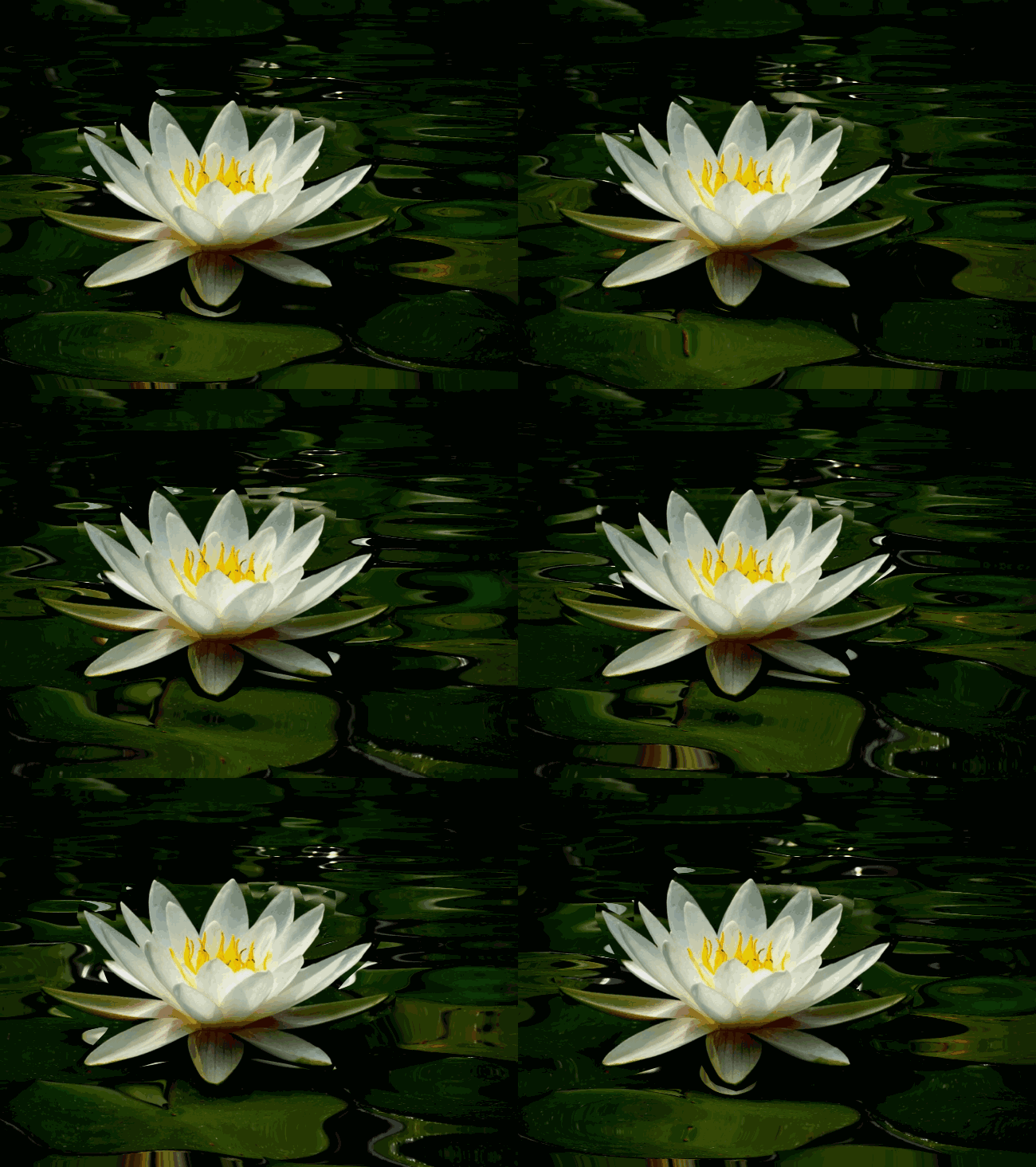
  3. Lotus Flower- symbol of purity and great beauty

    2

    What makes the lotus flower so special?

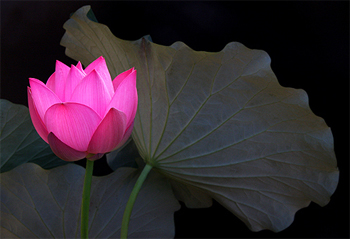
    The lotus flower is one of the most ancient and deepest symbols of our planet. The lotus flower grows in muddy water and rises above the surface to bloom with remarkable beauty. At night the flower closes and sinks underwater, at dawn it rises and opens again. Untouched by the impurity, lotus symbolizes the purity of heart and mind. The lotus flower represents long life, health, honor and good luck.

    The lotus (Sanskrit and Tibetan padma) is one of the Eight Auspicious Symbols and one of the most poignant representations of Buddhist teaching.

    The roots of a lotus are in the mud, the stem grows up through the water, and the heavily scented flower lies pristinely above the water, basking in the sunlight. This pattern of growth signifies the progress of the soul from the primeval mud of materialism, through the waters of experience, and into the bright sunshine of enlightenment.

    Though there are other water plants that bloom above the water, it is only the lotus which, owing to the strength of its stem, regularly rises eight to twelve inches above the surface. Continue reading

  4. A five minute introduction

    Comment

    • What is Buddhism?

    Buddhism is a religion to about 300 million people around the world. The word comes from ‘budhi’, ‘to awaken’. It has its origins about 2,500 years ago when Siddhartha Gotama, known as the Buddha, was himself awakened (enlightened) at the age of 35.

    • Is Buddhism a Religion?

    To many, Buddhism goes beyond religion and is more of a philosophy or ‘way of life’. It is a philosophy because philosophy ‘means love of wisdom’ and the Buddhist path can be summed up as:

    (1) to lead a moral life,
    (2) to be mindful and aware of thoughts and actions, and
    (3) to develop wisdom and understanding.

    • How Can Buddhism Help Me?

    Buddhism explains a purpose to life, it explains apparent injustice and inequality around the world, and it provides a code of practice or way of life that leads to true happiness. Continue reading

  5. Introduction to loving kindness meditation

    Comment

    The Metta Bhavana is a meditation for developing lovingkindness.

    “Bhavana” means “cultivation” or “development,” and “Metta” is a word that means “love,” “friendliness,” or “lovingkindness.” So this is a meditation practice where we actively cultivate some very positive emotional states towards others, as well as to ourselves.

    This meditation practice helps us to bring more harmony into our relationships with others, so that we experience less conflicts, resolve existing difficulties, and deepen our connections with people we already get on with.

    This meditation helps us to overcome anger, resentment, and hurt. Continue reading

  6. Wisdom and Compassion: Two Sides of the Same Coin

    Comment

    The Master views the parts with compassion, because he understands the whole.
    (Tao Te Ching, Chapter 39)

    THE ESSENCE
    Wisdom and compassion are the essence of an enlightened life.

    Wisdom and compassion are inextricably linked. They are two sides of the same coin. They are a unit. Separating them is an artificial, intellectual act.

    When compassion is taken out of the equation, wisdom turns into worthless platitudes, which easily become destructive. Without compassion, wisdom degenerates into an escapist entanglement in concepts, theories and dogmas.

    Wisdom is more than just cleverness plus compassion. It differs in quality to a point where it may seem to have little to do with cleverness. Sometimes, the actions of wise people seem to go against common sense. In fact, wise people often act in ways which are considered foolish by clever people.

    The greatest love seems indifferent, the greatest wisdom seems childish.
    (Tao Te Ching, Chapter 41)

    They would, for example, sacrifice their own interests for the sake of others, or accept defeat, sometimes even their own destruction, when they had every chance of winning or escaping. They would refuse to speak in their own defense when it seems expedient to do so, or they would speak up when it means putting themselves in jeopardy. Often, wise people would ignore what seem like clever strategies, and choose suffering instead. Continue reading

  7. Buddhist Perspective on Time and Space

    Comment

    A dharma talk from the Hsi Lai Temple

    Dear Venerables and Dharma Friends,

    I am very grateful for the guidance of the Buddha which enables us to have such an outstanding cause and condition to listen to the Dharma in this time and space. Today, the topic that I will discuss is “the Buddhist perspective on time and space.”

    Time travels from the past to the present; it spans the past, present, and future. Likewise, space covers hundreds and thousands of realms; it spreads across all ten directions. For most living beings, time and space are just like the act of breathing: we breathe every moment yet are not conscious of this action. Depending on our individual make-up, we all have different understandings about time and space. For example, certain insects live for a day and are contented; humans live to seventy and are still not satisfied. We all confine ourselves to our own limited slice of time and space. From the Buddhist perspective of samsara, the cycles of rebirth, the life span of all sentient beings is limitless. Not only is space without bounds, time is also endless and cannot be measured. If we penetrate the ultimate truth of time and space, we can be liberated from the space defined by the four directions of north, east, south, and west and emerge from the time cocoon of seconds, minutes, days, and months. We then will be in the dimension of total freedom, and we will be able to experience what is described in the saying, “Clear cool water everywhere; Prajna flowers every moment.”

    I will now discuss the Buddhist perspective on time and space in four points.

    I. The Time and Space for All Living Beings

    The term “all living beings” includes not only human beings but also encompasses beings in the other five realms of existence: celestial beings, asuras, animals, hungry ghosts, and beings in the hell realm. What is the time and space for all living beings within the six realms of existence?

    We will first talk about time. Continue reading

  8. Rationality and Emotion

    Comment


    If you love rational thought and are attached to ideas and perceptions, then you tend to despise the emotions. You can notice this tendency if, when you start to feel emotions, you say, ‘I’m going to shut this out. I don’t want to feel those things.’ You don’t like to be feeling anything because you can get into a kind of high from the purity of intelligence and the pleasure of rational thinking. The mind relishes the way it is logical and controllable, the way it makes sense. It is just so clean and neat and precise like mathematics – but the emotions are all over the place aren’t they? They are not precise, they are not neat and they can easily get out of control.

    So the emotional nature is often despised. We are frightened of it. For example, men often feel very frightened of emotions because we are brought up to believe that men do not cry. As a little boy, at least in my generation, we were taught that boys do not cry so we’d try to live up to the standards of what boys are supposed to be. They would say, ‘You are a boy’, and so we’d try to be what our parents said we should be. The ideas of the society affect our minds, and because of that, we find emotions embarrassing. Here in England, people generally find emotions very embarrassing; if you get a little too emotional, they assume that you must be Italian or some other nationality. Continue reading

  9. Wat kiryvongsa Bopharam

    Comment

    This photo was taken by a genius 3-year-old boy.
    I think this 3-year-old photographer did an excellent job!
    Well, I would say this is one of my favorite photos!

  10. The Leaves are Falling Down

    Comment

    (to the tune of “The Farmer in the Dell”)

    The leaves are falling down
    The leaves are falling down
    School is here and fall in near
    The leaves are falling down.

    The leaves are falling down
    The leaves are falling down
    Some are red and some are brown
    The leaves are falling down.

    The leaves are falling down
    The leaves are falling down
    They tickle your nose and touch your toes
    The leaves are falling down.

    ~June Haggard


Live & Die for Buddhism

candle

Khmer Tipitaka 1 – 110

 ព្រះត្រៃបិដក

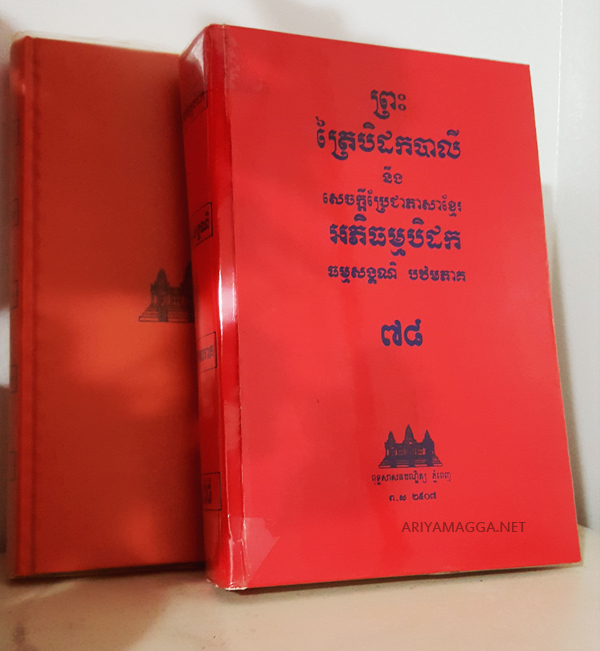
ព្រះត្រៃបិដក ប្រែថា កញ្រ្ចែង ឬ ល្អី​ ៣ សម្រាប់ដាក់ផ្ទុកពាក្យពេចន៍នៃព្រះសម្មាសម្ពុទ្ធ

The Tipitaka or Pali canon, is the collection of primary Pali language texts which form the doctrinal foundation of Theravada Buddhism. The three divisions of the Tipitaka are: Vinaya Pitaka, Sutta Pitaka, Abhidhamma Pitaka.

Maha Ghosananda

Maha Ghosananda

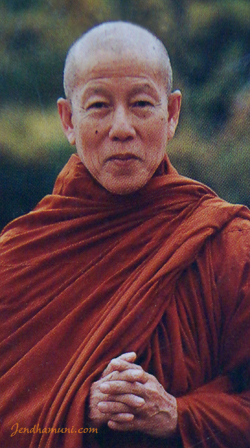
Supreme Patriarch of Cambodian Buddhism (5/23/1913 - 3/12/07). Forever in my heart...

Samdech Chuon Nath

My reflection

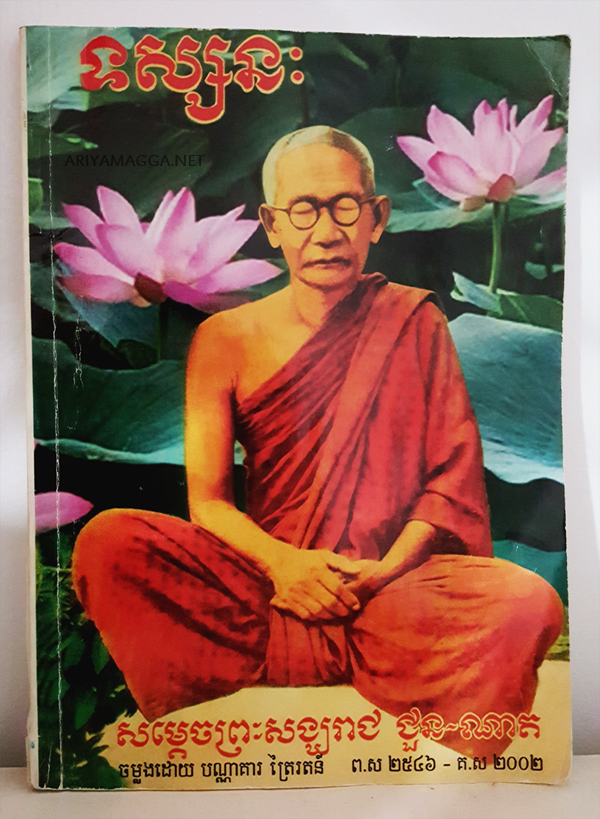
វចនានុក្រមសម្តេចសង្ឃ ជួន ណាត
Desktop version

Listen to Khmer literature and Dhamma talk by His Holiness Jotannano Chuon Nath, Supreme Patriarch of Cambodia Buddhism.

Shantidevas’ Bodhisattva vows

My reflection

Should anyone wish to ridicule me and make me an object of jest and scorn why should I possibly care if I have dedicated myself to others?

Let them do as they wish with me so long as it does not harm them. May no one who encounters me ever have an insignificant contact.

Regardless whether those whom I meet respond towards me with anger or faith, may the mere fact of our meeting contribute to the fulfilment of their wishes.

May the slander, harm and all forms of abuse that anyone should direct towards me act as a cause of their enlightenment.

As a solid rock is not shaken by the wind, so the wise are not shaken by blame and praise. As a deep lake is clear and calm, so the wise become tranquil after they listened to the truth…

Good people walk on regardless of what happens to them. Good people do not babble on about their desires. Whether touched by happiness or by sorrow, the wise never appear elated or depressed. ~The Dhammapada

Hermit of Tbeng Mountain

Sachjang Phnom Tbeng សច្ចំ​​ ភ្នំត្បែង is a very long and interesting story written by Mr. Chhea Sokoan, read by Jendhamuni Sos. You can click on the links below to listen. Part 1 | Part 2

Beauty in nature

A beautiful object has no intrinsic quality that is good for the mind, nor an ugly object any intrinsic power to harm it. Beautiful and ugly are just projections of the mind. The ability to cause happiness or suffering is not a property of the outer object itself. For example, the sight of a particular individual can cause happiness to one person and suffering to another. It is the mind that attributes such qualities to the perceived object. — Dilgo Khyentse Rinpoche

Nature is loved by what is best in us. The sky, the mountain, the tree, the animal, give us a delight in and for themselves. — Ralph Waldo Emerson


Our journey for peace
begins today and every day.
Each step is a prayer,
Each step is a meditation,
Each step will build a bridge.

—​​​ Maha Ghosananda